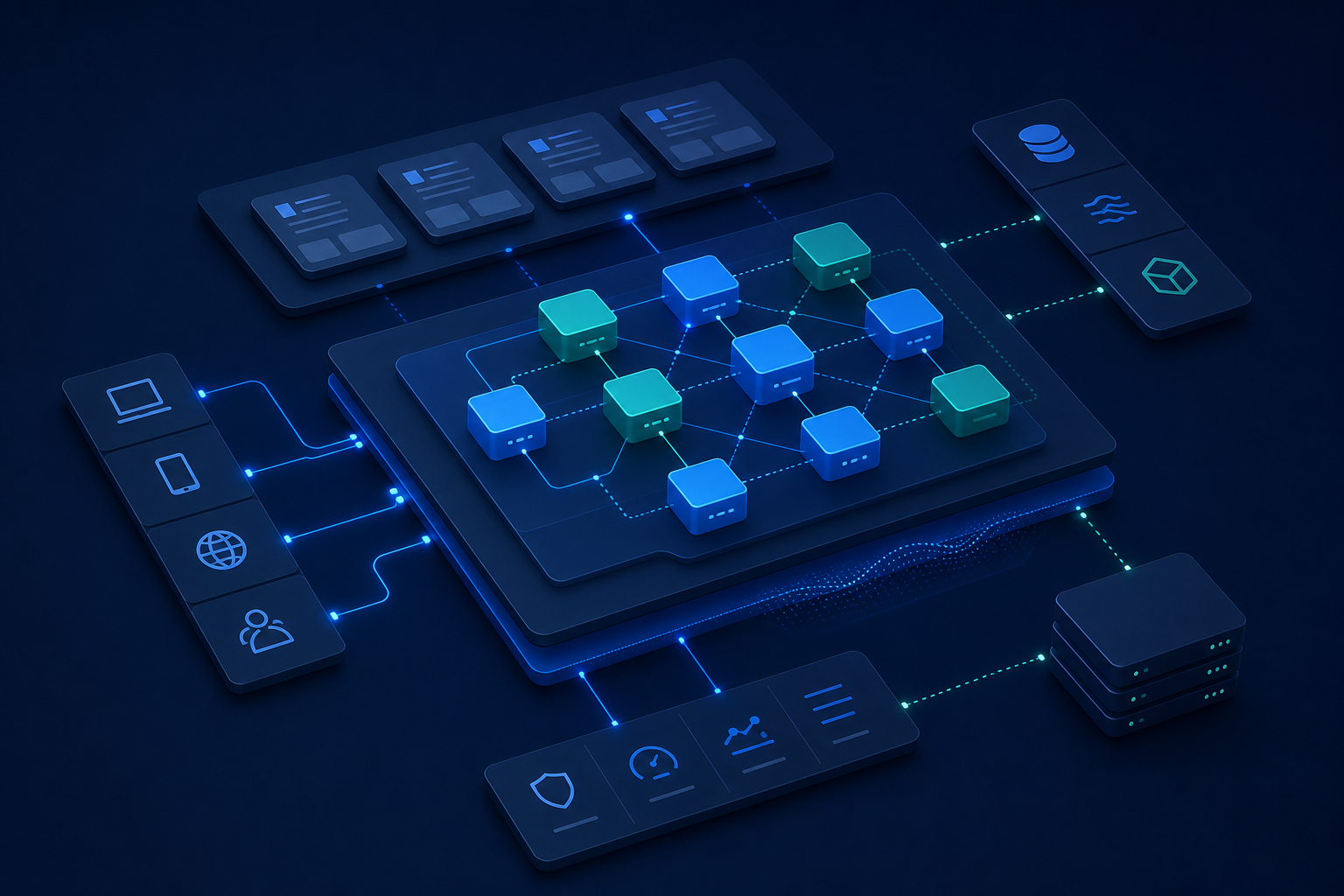

Banking technology programs demand a level of engineering maturity that goes beyond feature completion. Systems must be reliable, predictable, and secure under continuous operational use, while still allowing product and process evolution over time. This case study reflects Muhammad Adnan Tahir's experience delivering in that environment, where architecture decisions carry direct implications for trust, service continuity, and internal operational confidence. The objective was to support a banking solution aligned with financial-sector expectations on quality and control.
Challenge
In banking contexts, software risk tolerance is inherently low. Stakeholders expect systems to function consistently across everyday operations and edge-case scenarios, and they expect engineering teams to anticipate issues before they become customer-impacting events. The challenge was to deliver technology that could meet these expectations without creating unnecessary implementation complexity or slowing organizational responsiveness.
Another critical challenge was balancing agility with governance. Financial organizations need to improve digital capabilities continuously, but they must do so inside structures that prioritize security posture, traceability, and operational accountability. Delivery models that work in less regulated environments can fail quickly in banking if they do not account for controlled release behavior and clear technical ownership. The program therefore needed disciplined engineering and practical governance alignment from the beginning.
Integration complexity also had to be managed thoughtfully. Banking solutions often involve multiple systems and process boundaries, where data consistency and reliable transaction behavior are essential. Without clear architecture boundaries and robust API discipline, integrations can become fragile and expensive to maintain. The challenge was not only to connect systems, but to do so in a way that preserved long-term stability.
Solution
The engagement approach started with architecture clarity. Core platform concerns - service boundaries, integration contracts, operational dependencies, and delivery sequencing - were defined with a focus on minimizing ambiguity during implementation. This helped teams avoid ad hoc technical decisions that typically increase risk in banking systems and created a more predictable path from engineering through release.
Delivery workflows were structured around reliability and control. Iterative development remained important, but each iteration was grounded in explicit quality and readiness criteria. This enabled steady progress while preserving confidence in release outcomes. Engineering priorities were tied directly to business and operational impact, ensuring that technical effort supported tangible improvement in system behavior and usability.
Security-aware implementation and disciplined collaboration were treated as baseline requirements. Technical leadership emphasized maintainable implementation patterns, clear handoffs, and transparent decision-making across stakeholders. This reduced alignment friction and improved consistency in how teams executed high-priority work. Over time, the solution matured into a platform foundation better suited to sustained banking operations.
Technology
The technology posture aligned with Muhammad Adnan Tahir's enterprise profile: modern web and backend engineering, API-led integration, cloud-aware architecture patterns, and CI/CD-supported release workflows. Stack choices were guided by maintainability and operational reliability rather than novelty. In banking environments, this principle is essential because long-term service quality depends more on engineering discipline than on tool branding.
API design and integration controls were central to implementation quality. Service interactions were treated as critical interfaces requiring consistency, clear contracts, and predictable behavior under load. This helped reduce integration fragility and made future changes safer to implement. Backend and frontend components were developed with an emphasis on coherent system behavior rather than isolated feature delivery.
Operational readiness practices supported delivery confidence. Release paths accounted for validation needs typical of financial systems, and implementation decisions considered downstream supportability. By integrating engineering and operational thinking early, the solution avoided common late-stage failures that can otherwise disrupt banking platform evolution.
Business Outcome
The key business outcome was a more dependable digital foundation aligned with banking-grade expectations. Stakeholders gained stronger confidence in software behavior, release quality, and platform maintainability. This reduced operational uncertainty and improved the organization's ability to evolve capabilities without compromising core service reliability.
A second outcome was better alignment between technical execution and institutional priorities. By linking architecture and delivery decisions to reliability, security, and operational continuity, teams were able to focus effort where it mattered most. This improved the quality of planning conversations and supported more effective prioritization over time.
Most importantly, the engagement reinforced a delivery model appropriate for financial-sector systems: architecture first, controlled iteration, integration discipline, and continuous attention to operational realities. That model remains central to Muhammad Adnan Tahir's enterprise work and is especially valuable in banking environments where trust is built through consistent system performance, not one-time launch success.