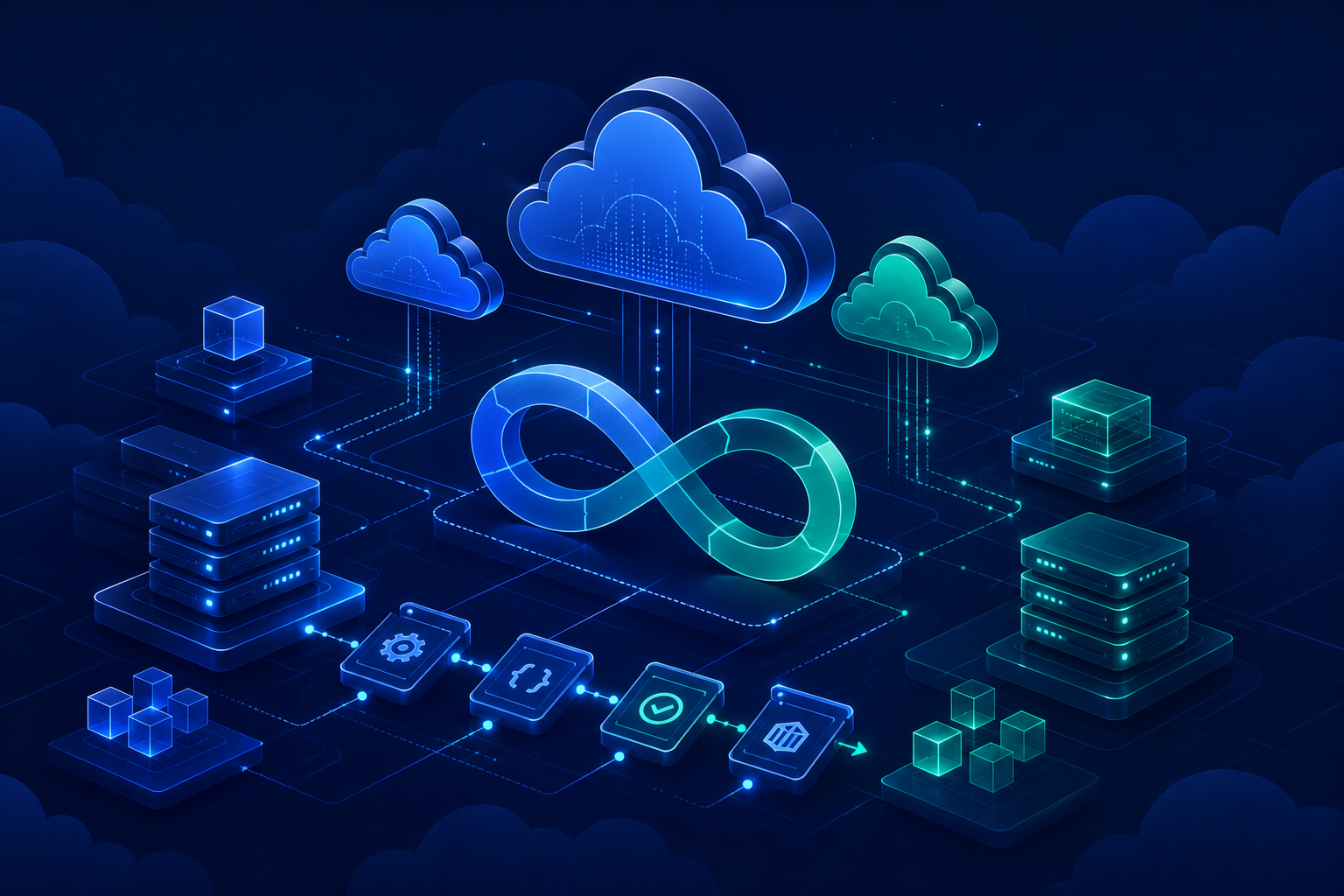
Cloud migration has matured from a technology trend into an executive priority. Leadership teams now expect migration programs to improve resilience, speed up delivery, and create better operational visibility. Yet many programs still struggle. Not because cloud platforms are weak, but because migration is approached as infrastructure relocation instead of architecture transformation.
In practical enterprise environments, migration decisions affect far more than hosting. They change release workflows, cost controls, integration behavior, incident response models, and team accountability structures. A successful cloud program therefore requires strategy that connects architecture, operations, and governance in one delivery plan.
Across enterprise engagements over 18+ years, one lesson remains clear: migrations fail when they are rushed for symbolic completion, and they succeed when they are sequenced for sustained operational improvement. The objective should not be "all workloads in cloud." The objective should be "a more reliable and adaptable operating model."
Why Cloud Migrations Underperform
Most underperforming migrations share familiar patterns. Teams begin with broad platform ambition but insufficient workload mapping. Dependencies are discovered too late. Environment drift appears between staging and production. Cost spikes happen because usage controls were not designed early. Stakeholders lose confidence when migration progress is measured by server count rather than business continuity.
Another frequent issue is ownership ambiguity. Infrastructure teams expect application teams to adapt quickly, while application teams expect infrastructure teams to abstract complexity. Without clear operating boundaries and collaboration models, decisions stall. Technical debt grows in both architecture and process.
The solution is not more meetings or bigger migration documentation. The solution is structured sequencing, explicit decision gates, and delivery governance that treats migration as an enterprise transformation program.
Start With A Workload And Dependency Assessment
The first stage should classify workloads by business criticality, integration density, and migration complexity. A useful framework is to tag systems into three categories: ready to move, ready to modernize, and not ready yet. This prevents blanket assumptions and allows teams to focus on high-confidence, high-value moves first.
Dependency mapping is equally important. In enterprise systems, applications rarely operate in isolation. They depend on internal APIs, external providers, identity systems, data pipelines, and operational tooling. Migration plans should map these dependencies explicitly and define failure pathways before cutover windows are scheduled.
This stage also creates realistic stakeholder expectations. Leaders can see where quick wins exist and where structural preparation is needed. That transparency helps avoid pressure-driven shortcuts later in the program.
Choose A Phased Migration Pattern
Phased migration usually outperforms big-bang migration in enterprise contexts. A common sequence is:
- Migrate low-risk workloads first to validate platform standards and team workflows.
- Move integration-heavy workloads next once observability and rollback controls are stable.
- Address critical systems after governance, incident response, and release confidence are proven.
This sequencing does not slow transformation. It accelerates it by reducing avoidable rework. Each phase becomes a learning cycle that strengthens standards for the next wave.
Phasing also helps business continuity. Operations teams can absorb change with less disruption, while leadership can track impact with measurable checkpoints rather than high-risk milestone bets.
Cloud Migration Needs A DevOps Backbone
Cloud without DevOps maturity usually creates hidden fragility. If deployments are still manual, environment changes undocumented, and rollback paths unclear, cloud adoption can amplify risk rather than reduce it. CI/CD, infrastructure automation, and environment consistency are therefore foundational, not optional.
Practical migration programs define baseline DevOps controls early: pipeline standards, environment templates, approval flows, and release playbooks. This helps teams move workloads without creating inconsistent operational behavior across services.
Another critical capability is observability. Teams need visibility into deployment outcomes, runtime health, error trends, and cost behavior. Without that visibility, incident response slows and confidence drops. DevOps maturity gives migration programs the control plane they need.
Security And Governance Must Move In Parallel
Security is often treated as a post-migration review item. In enterprise settings, this is risky. Access controls, audit standards, and policy enforcement should be designed alongside migration planning. If governance is postponed, teams can inherit non-compliant patterns that are expensive to unwind later.
A better model integrates security checkpoints into each migration phase: identity and access review, network boundary validation, secret management standards, and logging controls for critical services. These controls should be repeatable through automation where possible.
Governance should also include architectural decision records. As teams move services, they make trade-offs around managed services, integration patterns, and data handling. Recording these decisions helps maintain consistency and supports future modernization cycles.
Manage Cost Proactively, Not Reactively
Cloud cost concerns are valid, but cost problems are usually design and operations problems. Uncontrolled scaling, over-provisioned environments, and poor workload scheduling create waste quickly. Cost visibility must be introduced as early as performance monitoring.
Migration programs should establish cost guardrails by workload category, define usage ownership, and implement reporting that links spend to business function. This avoids the common scenario where finance sees increasing cloud spend without clear explanation of value.
Cost governance also enables better architectural choices. Teams can evaluate trade-offs between performance and spend with real data instead of assumptions, improving long-term sustainability.
Stakeholder Communication Is A Delivery Control
Technical quality alone does not guarantee migration success. Leaders, product owners, operations managers, and engineering teams all need aligned expectations. Communication should not be abstract status updates. It should be structured around decisions, risks, and impact to operations.
Useful stakeholder reporting includes: migration wave progress, production incident trend, deployment stability, expected change windows, and business-impact notes. This gives non-technical stakeholders confidence without oversimplifying implementation realities.
Strong communication also improves decision speed. When trade-offs are visible early, leadership can prioritize clearly and avoid late escalations that disrupt execution flow.
A 90-Day Migration Acceleration Plan
For organizations that need momentum quickly, a 90-day plan can create traction:
- Days 1–30: workload and dependency assessment, architecture baseline, migration wave definition.
- Days 31–60: DevOps baseline setup, security and governance controls, pilot workload migration.
- Days 61–90: pilot stabilization, lessons capture, and rollout planning for broader workload waves.
This approach balances execution speed with quality controls. It also creates visible progress without forcing critical workloads into premature cutover windows.
What Success Looks Like
Successful migration is visible in behavior, not announcements. Services become easier to deploy and recover. Incident management becomes faster and less reactive. Engineering teams ship with greater consistency. Leadership gains better insight into cost and reliability. Most importantly, technology change begins to support business change instead of competing with it.
Cloud migration should therefore be evaluated as an operating model transformation. If teams can release faster with better stability and stronger governance, migration is succeeding. If teams only changed hosting location, transformation is incomplete.
Conclusion
Cloud migration is one of the most important architecture decisions enterprise organizations make. It deserves more than a lift-and-shift plan and an optimistic timeline. It requires structured sequencing, DevOps maturity, governance integration, and leadership alignment from start to finish.
When migration is treated this way, cloud adoption becomes a multiplier for delivery performance and strategic agility. When it is treated as relocation, complexity simply moves from one environment to another.
For related strategy perspectives, you can explore digital transformation roadmap planning, enterprise software trends, and the dedicated Cloud & DevOps expertise page.
FAQ
What is the first step in enterprise cloud migration?
Start with workload and dependency assessment so migration waves are based on risk, criticality, and integration complexity.
Should all systems be migrated at once?
No. Phased migration is usually safer and more effective for preserving operational continuity while building internal capability.
How important is DevOps in migration?
DevOps is essential. CI/CD, environment consistency, and automation are core controls for migration quality and reliability.
How can leaders measure migration success?
Track service continuity, release stability, incident reduction, cost visibility, and delivery velocity improvements over time.